
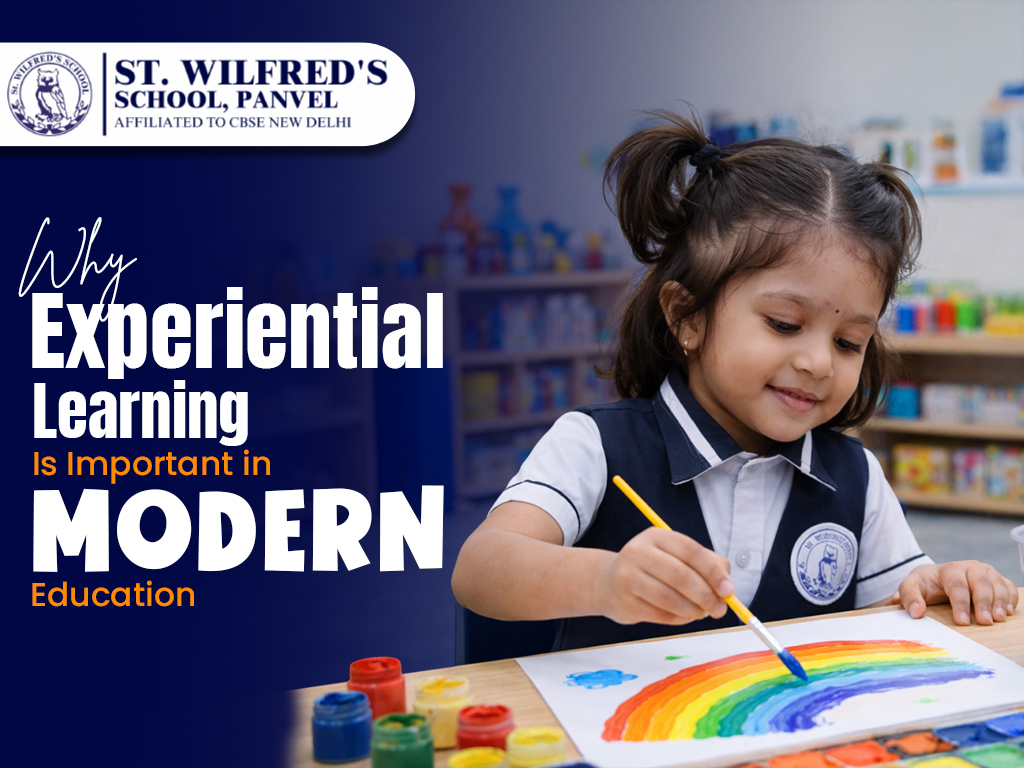
For children of all ages, being used to understanding every concept in-depth and working actively on their skill development is important for their future. In other cases, students may score high in exams but do not remember the concepts or their practical applications for a long time. The gap between knowledge and application has made experiential learning crucial for them in schools. This is where experiential learning plays a crucial role in preparing children to gain better knowledge and skills. The same is incorporated in the teaching measures, and the curriculum followed in modern education.
What is Experiential Learning?
Experiential learning is a method of education where students do not rely solely on lectures or textbooks for their learning, but also participate in activities and engage with the concepts they are introduced to in books, and learn better from the reflection of those experiences. In the present time, experiential learning can help boost the concept retention rate of students and take it as high as 90%, way more than traditional learning. When you enroll your child at the best school in Panvel for them to get exposure to experiential learning, the following are the key characteristics that they will be exposed to.
- Learning through real-world or simulated experiences
- Reflection as a core part of understanding
- A continuous cycle of action and improvement
- A student-centered approach
What is the Importance of Experiential Learning?
Every parent new to this concept would definitely be curious about the importance of experiential learning in modern education system. As an answer to them, it is important because it bridges the gap between theory and practice and, in the process, helps students develop practical skills, critical thinking, and adaptability. Its importance is supported by results, which include 83% of parents across the world reporting improvement in their child’s report cards as well as daily life habits as a benefit of experiential learning. The many importances of this approach of learning include:
- Helping students apply theoretical knowledge in practical contexts
- Building confidence through practical problem-solving and reflection
- Preparing students for dynamic and unpredictable work environments
- Encouraging lifelong learning habits
What are the Benefits of Experiential Learning?
There are a number of academic, cognitive, and personal benefits of experiential learning that are necessary to gain for the present and future of students. According to the Association for Experiential Education (AEE), 85% of students in experiential programs make substantial gains or hone their critical thinking and problem-solving skills. The following are some benefits explained in detail:
1. Enhances Engagement and Motivation
Traditional methods of learning are considered uninteresting by a huge number of students, which often leads to disengagement, which is one of the biggest student problems in today’s education system. Experiential methods make learning interactive and interesting, and hence increase the mental presence of students in their class.
- Students take ownership of their learning
- Participation in activities generates curiosity and excitement
- Reduces their reliance on rote memorization of topics
2. Improves Knowledge Retention
Students tend to remember concepts better when they actively engage with them rather than just read about them. The National Society for Experiential Education (NSEE) reported that the academic performance of students increases by 20% due to experiential learning. Such a benefit is a result of:
- Practical activities that reinforce memory
- Real-life application of concepts that strengthen understanding
3. Develops Critical Thinking and Problem-Solving Skills
One reason why experiential learning is important is that it exposes students to real challenges where solutions are not predefined and need to be discovered by them on their own. This builds and sharpens their analytical thinking and decision-making as it:
- Encourages questioning and exploration
- Promotes logical reasoning and evaluation
- Builds the ability to handle complex situations
How Do Students Get Experiential Learning in Education?
Experiential learning is a part of STEM education in schools across India. Hence, its benefits are also associated with the benefits of STEM education. Students gain experiential learning through structured activities that involve real-world interaction, practical tasks, or simulations. The following are some examples of how students indulge in experiential learning in education.
1. Project-Based Learning (PBL)
Project-based learning at schools involves solving real-world problems over a given time period for students to research, collaborate, and present their projects. Such a way of learning:
- Encourages teamwork and research skills
- Connects classroom knowledge to real-life issues
- Promotes independent learning
2. Lab Work and Practical Sessions
In subjects like science and engineering, experiential learning through practical sessions is important to improve the understanding of theoretical concepts among students and also introduce them to new ones. Such a measure helps by:
- Reinforcing classroom learning
- Developing technical skills
- Encouraging experimentation
3. Field Visits and Community Engagement
Experiential learning is not limited to just classrooms or labs but also involves students connecting with the real-world in the form of field visits or community engagement. Activities like these are valuable because they:
- Encourages social responsibility
- Builds awareness of real-world challenges
- Promotes experiential understanding
Conclusion
In the present time, experiential learning is a critical component of modern education because it equips students with the skills, confidence, and adaptability needed in a rapidly changing world. Additionally, this method of learning also acts as a bridge between memorizing concepts theoretically and honing their understanding for a long time by participating in their applications.
Enroll your child at St. Wilfred’s School, Panvel, and get them to benefit from experiential learning methods, which help them understand and remember valuable concepts and develop skills lifelong.
FAQs
Q. What is experiential learning in simple words?
Experiential learning means learning by doing practicals of the concept you learn, along with reflecting on the experience of your practicals.
Q. What is the best example of experiential learning?
Some of the best examples of experiential learning are making projects, working in labs, doing field visits, and participating in role-playing activities.
Q. What are the 4 pillars of experiential learning?
The 4 pillars of experiential learning are concrete experience, reflective observation, abstract conceptualization, and active experimentation.