
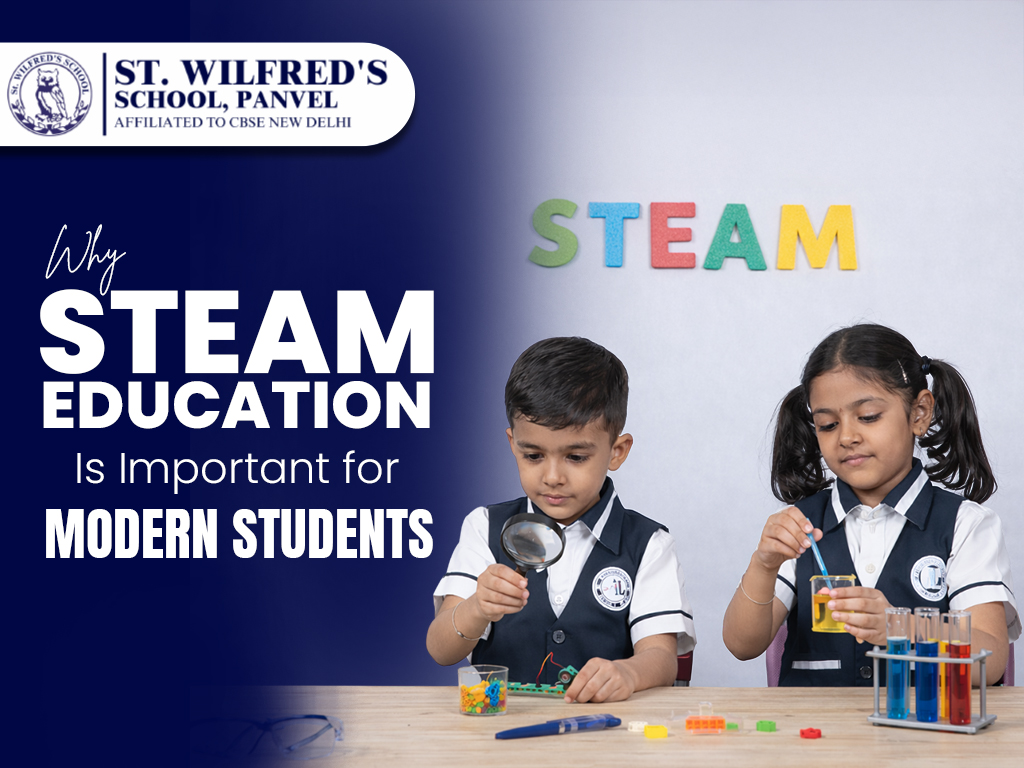
A world where students do not memorize formulas but instead use those concepts to build robots, create apps, or design solutions to real problems. This type of world is not far away, as the e-world is evolving at an unprecedented pace. Traditional education alone can not help students, and that is exactly where STEAM education steps in.
From the best schools in Panvel to classrooms in metropolitan cities to forward-thinking institutions, they are redesigning concepts of learning. In this blog, we explore what STEAM education is, why it matters, and how it shapes the students of tomorrow.
What Is STEAM Education?
STEAM stands for Science, Technology, Engineering, Arts, and Mathematics. It is different from traditional education, which prioritises subject-focused teaching; STEAM education is an integrated approach that connects these aspects to encourage hands-on projects and inquiry-based learning.
The addition of the arts to the original STEM framework creates a significant difference, bringing in new skills such as creative thinking, communication, and humanities. It ensures students think innovatively and thoughtfully while solving problems.
The Core Benefits of STEAM Education
The benefits of STEAM education extend well beyond the classroom. Here’s a closer look at what students gain:
1. Builds Critical Thinking and Problem-Solving Skills
STEAM challenges students to think critically as they solve problems. Through hands-on projects, students learn to analyze situations, test hypotheses, and find solutions independently. This type of thinking is needed and valued by recruiters across all career fields today.
2. Encourages Creativity and Innovation
STEAM learning for students opens up creative avenues by delving into technical subjects. A student designing a bridge doesn’t just calculate loads; they also consider aesthetics, user experience, and sustainability.
3. Prepares Students for Future Careers
According to global workforce trends, in the future, the majority of recruiters will require some level of digital literacy and technical skills. STEAM education aligns school learning with these demands, giving students a competitive edge in fields like artificial intelligence, data science, architecture, medicine, and more.
4. Develops Collaboration and Communication
STEAM projects are rarely solo efforts. Mainly, students work in teams, communicate ideas, delegate tasks, and present findings. These are exactly the workplace skills that employers consistently rank as top priorities.
Why STEAM Learning Matters for Students Today
We are living in a world of rapid technological change. Climate challenges, healthcare innovations, and smart cities all require multidisciplinary thinking. STEAM learning equips students to engage meaningfully with these difficult challenges.
Moreover, STEAM promotes a growth mindset. When a science experiment fails or a code doesn’t run, students learn resilience, iteration, and perseverance, qualities that define lifelong learners and successful professionals.
It also bridges the gender gap in technical fields. Digital learning at the best CBSE school in Navi Mumbai, STEAM makes science and technology creative and collaborative, drawing in students who may have previously felt excluded from these subjects, making education more inclusive and equitable.
How the Best Schools Are Embracing STEAM
The importance of STEAM education has not gone unnoticed by leading educational institutions. Progressive schools are investing in state-of-the-art labs, maker spaces, coding curricula, and project-based learning environments.
For instance, it is already transforming how students interact with knowledge. From smart classrooms to robotics clubs, these schools are making STEAM an essential part of daily education rather than a separate module.
The best CBSE schools in Panvel that embed STEAM into their core curriculum ensure that students don’t just memorize the concepts but actually apply them through interdisciplinary projects, competitions, and real-world challenges. When students see the connection between a math concept and a coding problem they’re working on, learning becomes genuinely exciting.
Great schools understand that STEAM isn’t just about technology; it’s about nurturing curious, capable, and compassionate human beings who are ready to make a difference.
Conclusion
The world your child will enter is vastly different from the one you grew up in. Preparing them for it requires more than textbooks and exams; it requires an education that’s dynamic, interconnected, and future-focused. That is the promise and power of STEAM education.
Whether your child dreams of becoming an engineer, an artist, a doctor, or an entrepreneur, STEAM education lays the foundation for all of it. As parents and educators, we have a responsibility to choose schools that take this vision seriously.
If you’re looking for an institution that champions innovation-led learning, start your search with us and see how quality STEAM programs are shaping brighter futures, one curious student at a time.